Another thing.
I don't want the government to send me any money.
Nor do I want it to forgive student debt in its attempt to address the economic tsunami that's on the horizon.
If the government's going to start issuing checks, I'd much rather it focus on small businesses, helping them weather this storm and come out on the other side or providing cash to hourly employees who have been let go. Or come up with creative ways of mitigating the pain broadly speaking for some of these small business. For instance, in one article I read the other day, the authors suggested the government shouldn't be writing checks to everyone. Rather, it could issue debit cards which could be used after this is over, once we come out on the other side, when we all emerge from our caves and look around to see what's left (assuming we emerge, that is)
The cards could only be used to boost the economy, focusing only on those businesses that we shut down (by government decree in the interest of slowing down the spread of the contagion). When the restaurants and the theaters and the amusement parks and the bars and the concerts and the caterers all put up their shingles again, consumers could use the cards for only for these venues. In other words, we couldn't use the cards to buy a new couch or something. This would have the effect not only of injecting cash back into economy down the road, but also would serve as a sort of guarantee to lenders (now) that money would be coming back later.
I really like that idea. I like it when people start to think rather than react.
Sunday, March 22, 2020


More Random Thoughts: Coronavirus Pandemic 2020
More random thoughts.
I'm no Trump apologist, so feel free to take this or leave it, but I'm noticing a constant mantra on Facebook (and probably elsewhere) about this Covid 19 pandemic and the flawed response by the government which, many claim, can be traced directly to Trump's defunding of the Center for Disease Control and the National Institute of Health.
I decided to see what the fact checkers were saying on this claim. Apparently, this depiction of the situation is not true, or at least, it's not true in practice (though it may be true that Trump wanted to defund these institutions).
As is often the case, the facts are more complicated than the charges.
Linking below a few fact-check sources.
Besides the complexity of funding issues and the tendency among partisans of both parties to blame the chief executive for failures in crises like this ("this is Trump's Katrina"), another important perspective that no one's talking about has to do with individual states' readiness. I found an article that analyzes states' readiness for pandemics individually. Interestingly enough, my state, the Golden State, was among the least prepared, financially, in terms of readiness.
I wish it were possible to discuss this terrible pandemic without the requisite partisan bickering, but I suppose that's wishful thinking. I'm pretty sure if this were President Biden making all kinds of mistakes and blunders the partisans on the right would be doing the same thing. It's not just a mad mad world, it's a sad and ugly world, as well.
Politics.
Reading
"Democrats' Misleading Coronavirus Claims" (FactCheck.org)
Random Thoughts: Coronavirus Pandemic 2020
Random thought.
Say we go two more months of social distancing, confinement, shelter-in-place, business and restaurant closures, school closures, cancellation of sporting and cultural events, government distribution of checks to individuals and families, job losses, businesses shuttered.
And then the curve flattens, we breathe a sigh of relief, start to return to some semblance of normalcy.
And then, come fall, this virus returns.
What then? Lather, rinse, repeat?
You may say I’m a dreamer and you'd be correct. This is a nightmare.
Are we as a society really prepared to exist like this long-term? There will be another virus, then another. And now that our response to this one has been so fierce, I can’t imagine future responses being anything less. And our lives will never be the same.
Someone will chide. What choice did we have?
Does anyone think they know? Does anyone know for sure?
C.S. Lewis wrote in an essay called, “Is Success Possible? Willing Slaves of the Welfare State,” that a caged animal isn’t hungry. That’s the trade-off, I think. We’re so afraid. Terrified of this stalking monster. Cage me, and I’ll be safe.
I’ve offended some of you, I know. But someone somewhere among my friends
on Facebook said we should be writing our thoughts during this terrible time.
And so I have. And I'll continue.
Sorry in advance to all who will say, "Yeah but . . . "
I know the "Yeah, but . . . "
I already know who you are. And I'm among you saying it.
But have we really thought this through?
***
A few reads (sorry if they're behind a paywall).
"Is Our Fight Against Coronavirus Worse Than the Disease?" (David L. Katz, New York Times, March 20, 2020).
Comments:
The author is the founding director of the Yale-Griffin Prevention Research Center. I listened to an interview with him when the article appeared. He admits he writes against his own interest, having family members who are high risk. He also regrets taking a position that differs from his colleagues.

Say we go two more months of social distancing, confinement, shelter-in-place, business and restaurant closures, school closures, cancellation of sporting and cultural events, government distribution of checks to individuals and families, job losses, businesses shuttered.
And then the curve flattens, we breathe a sigh of relief, start to return to some semblance of normalcy.
And then, come fall, this virus returns.
What then? Lather, rinse, repeat?
You may say I’m a dreamer and you'd be correct. This is a nightmare.
Are we as a society really prepared to exist like this long-term? There will be another virus, then another. And now that our response to this one has been so fierce, I can’t imagine future responses being anything less. And our lives will never be the same.
Someone will chide. What choice did we have?
Does anyone think they know? Does anyone know for sure?
C.S. Lewis wrote in an essay called, “Is Success Possible? Willing Slaves of the Welfare State,” that a caged animal isn’t hungry. That’s the trade-off, I think. We’re so afraid. Terrified of this stalking monster. Cage me, and I’ll be safe.
I’ve offended some of you, I know. But someone somewhere among my friends
on Facebook said we should be writing our thoughts during this terrible time.
And so I have. And I'll continue.
Sorry in advance to all who will say, "Yeah but . . . "
I know the "Yeah, but . . . "
I already know who you are. And I'm among you saying it.
But have we really thought this through?
***
A few reads (sorry if they're behind a paywall).
"Is Our Fight Against Coronavirus Worse Than the Disease?" (David L. Katz, New York Times, March 20, 2020).
Comments:
The author is the founding director of the Yale-Griffin Prevention Research Center. I listened to an interview with him when the article appeared. He admits he writes against his own interest, having family members who are high risk. He also regrets taking a position that differs from his colleagues.
"Such is the collateral damage of this diffuse form of warfare, aimed at 'flattening' the epidemic curve generally rather than preferentially protecting the especially vulnerable. I believe we may be ineffectively fighting the contagion even as we are causing economic collapse."
He asks, "When does the society-wide disruption end?"
He answers: "We just don’t know. We could wait until there’s an effective treatment, a vaccine or transmission rates fall to undetectable levels. But what if those are a year or more away? Then we suffer the full extent of societal disruption the virus might cause for all those months. The costs, not just in money, are staggering to contemplate."
He answers: "We just don’t know. We could wait until there’s an effective treatment, a vaccine or transmission rates fall to undetectable levels. But what if those are a year or more away? Then we suffer the full extent of societal disruption the virus might cause for all those months. The costs, not just in money, are staggering to contemplate."
He has suggestions.
Is it too late to implement them?
This from the Wall Street Journal editorial board:

Smile at Strangers
Just a reminder. Don’t forget to smile at strangers.
And say good morning.
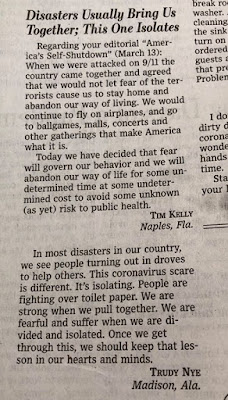
CoronavirusPandemic2020
And say good morning.

CoronavirusPandemic2020
Thursday, January 9, 2020
Therefore, What?
As 2019 came to a close, many in the Christian evangelical community were rattled by the publication of an editorial
in Christianity Today in which the author argues that Donald
Trump should be both impeached and removed from office and chastises
evangelicals who continue to support him: "Consider what an unbelieving
world will say if you continue to brush off Mr. Trump’s immoral words and behavior
in the cause of political expediency," the author chides.
Fair-minded people could probably debate the Christianity Today article. What I have a problem with is how people—mostly unbelievers, many of them
left-leaning or progressive, and some of them former Christians—are promoting
the article as if suddenly there's truth to be found in a
Christian magazine. It's not as if these people read the magazine for its
spiritual or doctrinal content; it's also not as if any of them would love to
meet for a glass of wine to discuss things having to do with the Christian
faith in general, let alone the impact of the Christian message on their own
lives. Rather, they share this piece prominently on (where else) social media
for no other reason than to bludgeon evangelical Christians who have the gall
to support Donald Trump despite his obvious moral and cognitive failings.
What bothers me is the implication
of their tsk tsks. Setting aside whether the articles of impeachment are valid or were politically motivated by an opposition party that was determined to impeach Trump before he was even inaugurated (I happen to
believe the latter); and setting aside whether or not previous presidents could
have been impeached for greater or even similar offenses but weren't; and
setting aside what amounts to gut-level disdain for Trump the man as
opposed to Trump the president (and by Trump the man I'm referring to his
coarseness and crudeness and moral failings and even his supposed
"unfitness" for office); setting aside these things—all of which have been debated
and discussed over the past three years and are still unresolved—I still have
to ask those who are scolding evangelicals for continuing to support Donald Trump in
spite of it all: Therefore, what?
Yes, it's true: Trump is crude.
Trump is boorish. Trump is impulsive. Trump is not presidential. Trump is
impetuous. No argument here. I never liked Donald Trump. I never watched The
Apprentice. I don't think I even gave Donald Trump a minute's thought until the moment he
rode down that elevator. And during the months leading up to the 2016 election,
I grew more and more depressed as one by one my preferred candidates fell away.
I remember texting a friend one day and asking if it was wrong for me to wish
Trump would choke on a piece of steak. But once he became the nominee, I had to
face facts, and ultimately I came to the conclusion that disputes about morals
and values or personal likes or dislikes have no place in a presidential
election when faced with a binary choice. A binary choice is what we were
faced with in 2016. "Pick your poison," I remember posting on
Facebook as election day drew near. And a binary choice is what we're faced with in 2020.
So, to my leftist friends, to my
ex-Christian friends, and even to my well-meaning fellow evangelical friends
who tsk, tsk those of us who will either reluctantly or
enthusiastically support Trump in 2020: Therefore, what? I
may agree that Trump is all that you say, but do you seriously expect me to
vote for your guy or gal? Even the tamer Dems vying for the
nomination have no place in the universe of core conservative objectives that I
value. The Democratic party has veered so far left--both in terms of the
economy and in terms of social issues--that frankly I'm surprised anyone who
hews even remotely to the center would consider aligning themselves with it.
So that's the dilemma I'm faced with
as I listen to the smug self-righteousness of those who promote the Christianity
Today editorial as if it were the equivalent of the gospel. As if they
really think someone like me is either going to vote Democrat or withhold a
vote for a Republican when the country has become so polarized. The time is
long past when our country had a strong "center," politically
speaking. I pray it returns, but meanwhile we're in the midst of a cultural
war, and Trump, for all his obnoxious and revolting ways, is, at least for now,
the person blocking the threshold to the progressive left's wave of cultural
and economic transformation. If anything, I'm disappointed
that influential Christians like those at Christianity Today can't
unite against the left. Instead, I'm detecting the stench of
"wokeness" emanating from the church, and the most "woke"
Christians are those who hate Trump. This troubles me much more than any of the
church's supposed blindness towards Trump's flaws. The way I see it, Trump is
just a blip. He's here now for one term, maybe two, but eventually he'll be
gone, both parties will survive, and our country will carry on. Societal
change, cultural change, on the other hand, once it's permeated the culture,
will remain long after he's gone.
Which brings me back to the Christianity
Today editorial. Christians are being called on the carpet for
apparently abandoning their mission (I'm thinking about the era of the Moral
Majority) as long as their "gladiator" is in the ring. Can we
Christians re-evaluate that era? Can we perhaps concede that it was wrong to
obsess about the moral character of leaders? Can we agree that politicians are
not pastors? Talk radio host Dennis Prager describes how, back during the
Clinton impeachment, he never mentioned even Monica Lewinsky's name on his
radio show. The sex life of public officials was not his concern (he says).
It's the job politicians do that matters, not their private morals. And Prager
is an observant Jew.
Do I agree? I think I do. I would
add that Donald Trump is not the first boorish man ever to hold public office,
nor will he be the last. Voters can look at what a leader does or advocates and
analyze the effect of these actions or policies on the things they value. What
else can we do? Again, we're not electing pastors.
*****
Further Reading
Trump Should Be Removed From Office, by Mark Galli
Trump Should Not Be Removed From Office: A Response to Mark Galli and Christianity Today, by Wayne Grudem
The Moral Majority (Wikipedia)
Subscribe to:
Posts (Atom)